3Jane's Next Step: Credit Beyond Crypto
Moving beyond collateral-based finance, 3Jane is connecting on-chain capital with credit markets outside crypto
- Sector
- DeFi
- Assets
- $JANE
- Published
- 2026-10-28by Musashi
From collateral to credit, and beyond crypto
What does a lender look at to decide whether a loan will be repaid? Traditional finance looks beyond the assets a borrower holds to income and cash flow, repayment history and the profitability of the business, and treats the money a borrower will earn as grounds for lending too
By contrast, DeFi, the financial services of crypto, widely uses overcollateralised loans, where the borrower first posts assets worth more than the amount borrowed. Here, the assets held today set the loan limit rather than the ability to repay in the future
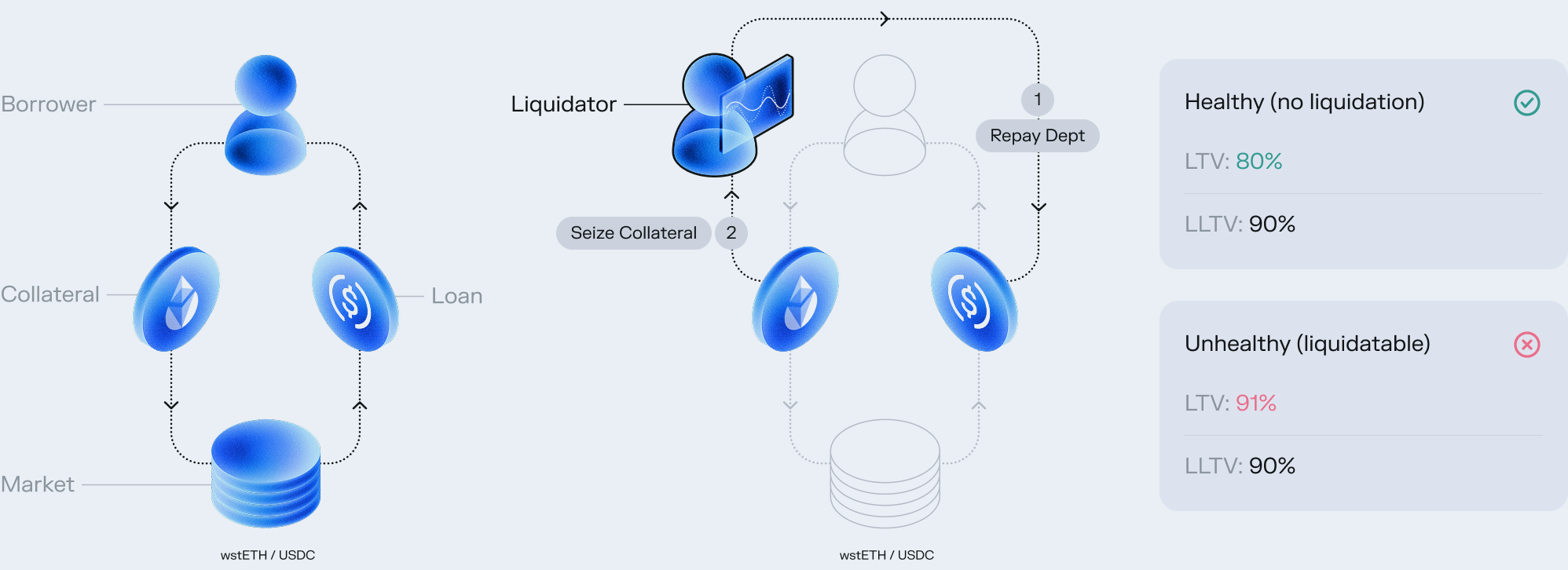
The figure below shows how lending and liquidation work on Morpho, a DeFi lending protocol. A loan is taken against collateral, and once the ratio of borrowed money to collateral value passes the liquidation threshold, a liquidator repays the debt and takes the collateral
That was why 3Jane caught my attention at the time. It set out to assess credit with on-chain and off-chain data and to offer the unsecured credit lines that existing DeFi could not
Looking at 3Jane's direction again recently, I think the opportunity is bigger than I first thought
3Jane's real growth opportunity may lie less in lending to crypto users without collateral and more in connecting on-chain capital with the vast credit markets that already exist outside crypto.
This shift can be read along two axes: FCC on the demand side, which widens the markets the money goes to, and LCC on the supply side, which changes how that money is raised
This piece looks at the problem each of FCC and LCC tries to solve, how far 3Jane could grow when the two work together, and what still has to be proven along the way
Fintech's rise and its funding limits
Over the past few years fintech companies, the online lenders, have reworked much of the traditional lending process. By assessing credit from bank accounts and transaction histories, company revenue and cash flow, they began lending to consumers and small businesses that traditional lenders had not served well
But another problem can appear here. However many customers and however sharp a credit model a lender has, it cannot grow if it lacks the capital to fund new loans
Traditionally that capital has come from credit lines with banks, private credit funds or institutional investors, or from agreements to sell them loan receivables. Setting these up takes considerable time and cost: legal structuring, contract negotiation, and managing disbursements and collections
So who funds a fintech that has borrowers and a credit model but not enough capital?
That is the gap 3Jane is going after. Rather than compete with fintechs for borrowers, it aims to become the financial infrastructure that supplies capital to fintechs that already have customers and loan demand
FCC: bringing loan demand outside crypto on-chain
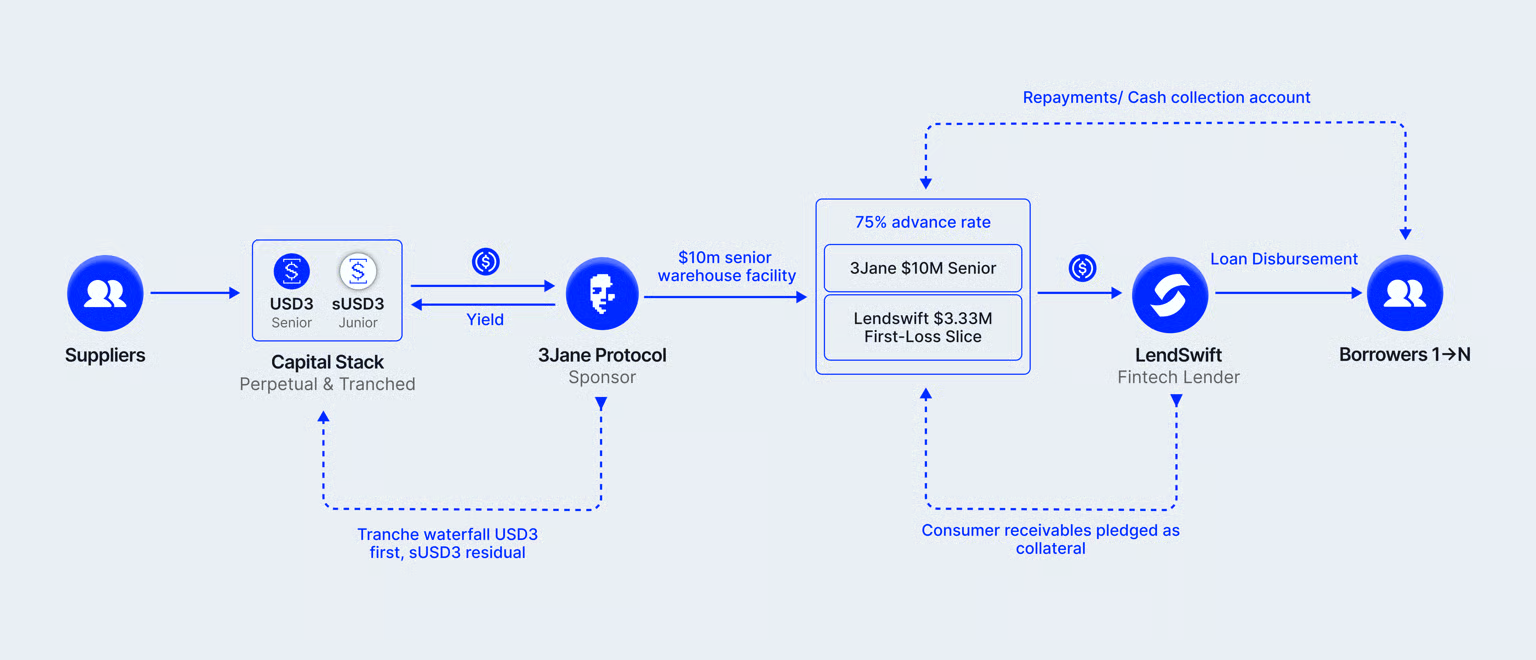
Through FCC (Fintech Credit Conduits), 3Jane funds the loan receivables that fintech companies originate. It works in two main ways: lending against receivables a fintech holds, or buying eligible receivables outright. Either way, the fintech can free up capital tied to existing loans or raise more to make new ones
The business is expanding quickly
On 1 June 3Jane announced a $10 million senior funding facility with LendSwift. On 9 June it followed with a Forward Flow programme with Slope, making its first purchase of about $8.5 million in Slope's business credit receivables under a $50 million Hold-Level
It bought about another $18 million in mid-June, and just six weeks later, on 22 July, cumulative Slope purchases passed $60 million, reaching the initial programme's Hold-Level
What stands out is not just the growing amount of capital but that receivables are actually being bought and collected over and over. According to an operating update published on 18 August, 3Jane bought 2,151 Slope receivables worth $90.8 million in total between 4 June and 11 August and collected about $36 million of that
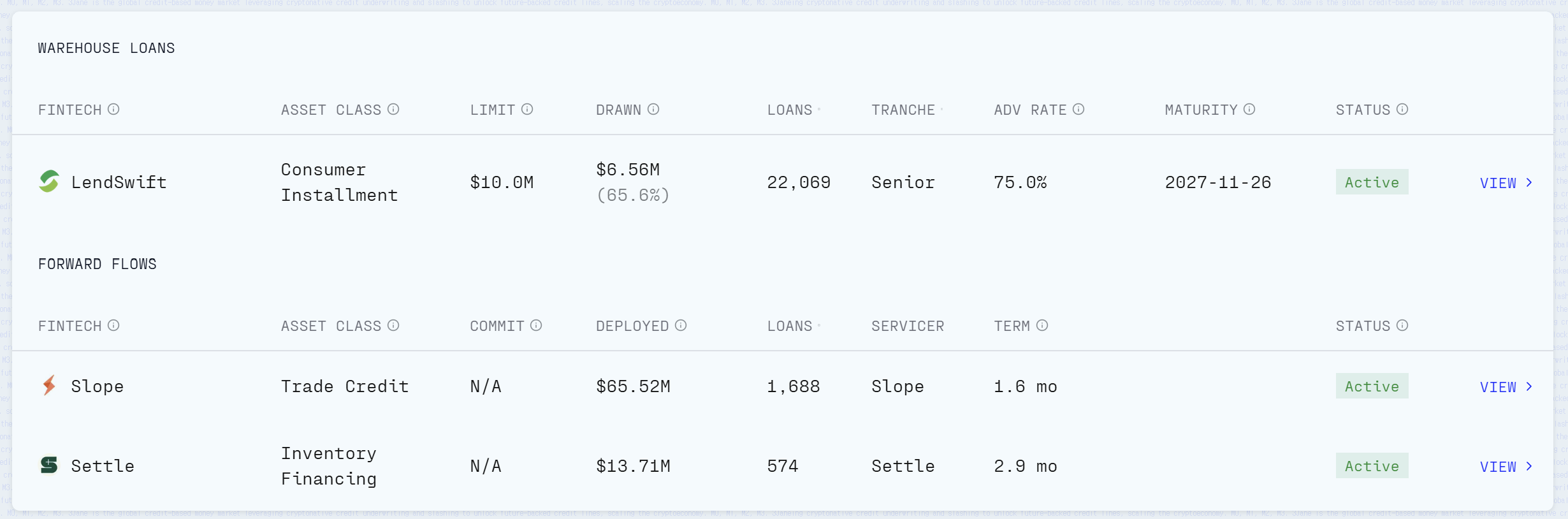
As of 27 October, when this piece was written, the 3Jane dashboard shows $65.52 million deployed with Slope, $13.71 million with Settle, which provides inventory financing, and $6.56 million with LendSwift, which makes consumer instalment loans. In total, $85.79 million is funding about 24,000 underlying loans across three fintechs
Within a few months of announcing its first deal in June, 3Jane is running about $85 million of loan receivables from outside crypto. Because these receivables are short-dated, capital can be redeployed into new loans each time principal is repaid, so if these deals keep repeating smoothly I think they can grow into a lasting funding channel
What matters in this structure is that the end customer does not have to be a crypto user. DeFi capital can fund credit demand that arises outside crypto, such as consumer instalment loans or a small business's inventory and working capital
Because 3Jane does not have to win consumers one by one or build credit assessment and collections from scratch, I think it scales far better than direct unsecured lending
In the Forward Flow deal with Slope, 3Jane stressed that USD3 lets it offer funding terms comparable to a traditional ABS (asset-backed security). That matters because a fintech can keep selling its receivables to raise capital without issuing an ABS of its own. Whether the actual cost of funding is competitive still needs to be tested
If this structure takes hold, 3Jane's funding opportunities can grow as its fintech partners' lending grows, and if new partners come on board, there is room to expand into more credit markets, such as consumer credit, business-to-business trade finance and inventory finance
I think the important potential here is that DeFi can go beyond recycling capital inside the crypto ecosystem and reach the loan demand and repayment cash flows of the real economy.
Growth in scale does not by itself mean stable returns, though. With about 76% of deployed capital concentrated in Slope, receivable quality, repayment performance and partner concentration need watching
One question remains. If the loan demand coming through fintechs keeps growing, how can 3Jane raise the capital it needs efficiently?
LCC: putting committed capital to work, not just deposited capital
First, 3Jane raises capital like a typical DeFi lending protocol, by taking USDC deposits. Depositors receive yield-bearing USD3, which they can stake into sUSD3, the junior position. USD3 is senior, so it is relatively protected from credit losses but earns less; sUSD3 absorbs losses first in exchange for a higher expected return
The capital raised this way funds the fintech receivables described above
In fintech lending, however, the time a funding commitment is made and the time the money is actually drawn often differ. Even if a lender agrees to provide a fintech with $100 million, the full amount is not needed on day one. It can be drawn over several months as new loans are made
If all the capital is raised up front through deposits, some of it sits idle until it is used. If it is raised only once loan demand appears, disbursement can be delayed
To address this inefficiency, 3Jane launched LCC (Levered Callable Capital) on 1 September
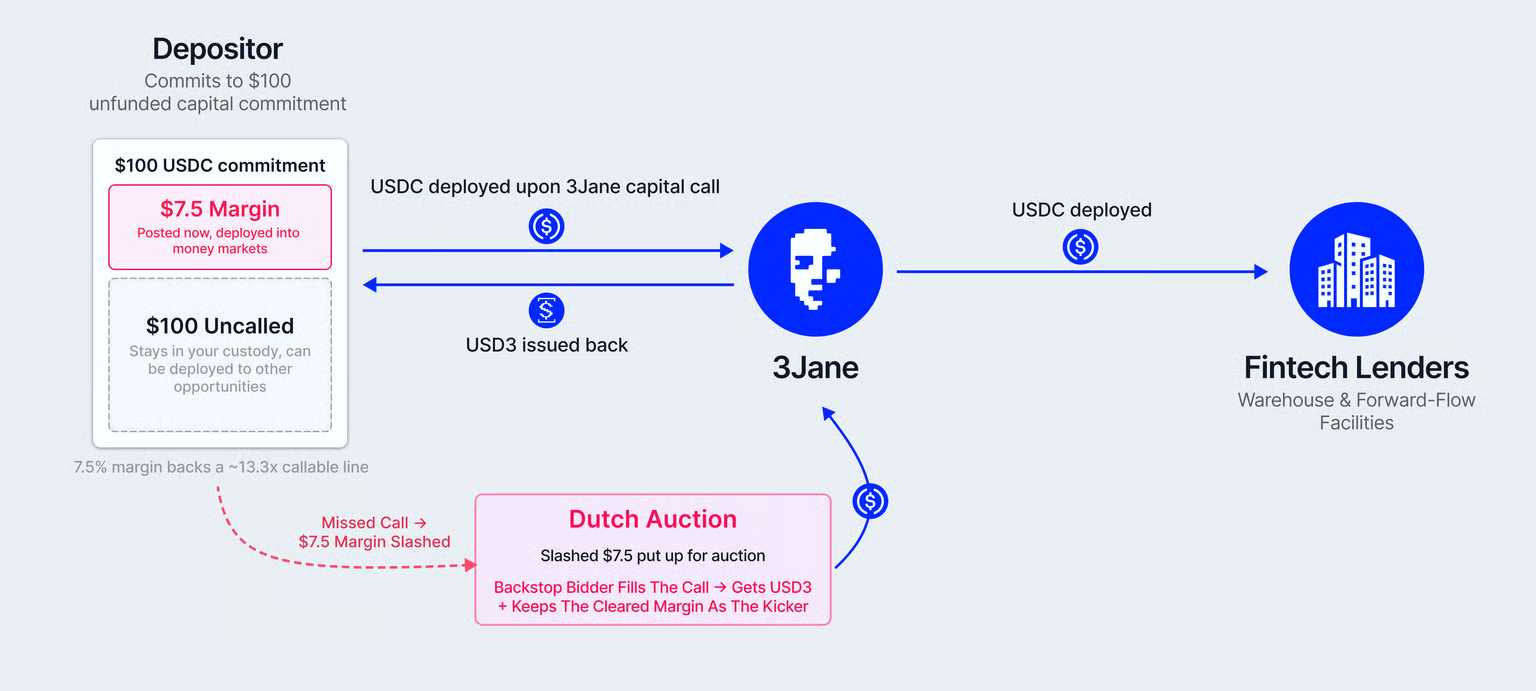
The core idea is that instead of depositing the full amount up front, a supplier posts only part of it as margin and commits to provide the rest when it is needed. Until a capital call comes, the supplier can hold the remaining assets or deploy them elsewhere, and earns a commitment fee in return
Under the terms at launch, committing to supply $1 million requires $75,000 (7.5%) in margin. The commitment fee is 1.25% a year, so a commitment held for a full year earns $12,500
That is about 16.7% on the margin posted. But the supplier carries an obligation to provide $1 million in the future, so it is not simply a high-yield deposit
When lending requires capital, 3Jane makes a capital call and the supplier must pay in USDC within nine days. If it fails to do so, its margin is auctioned off to induce another participant to supply the capital instead
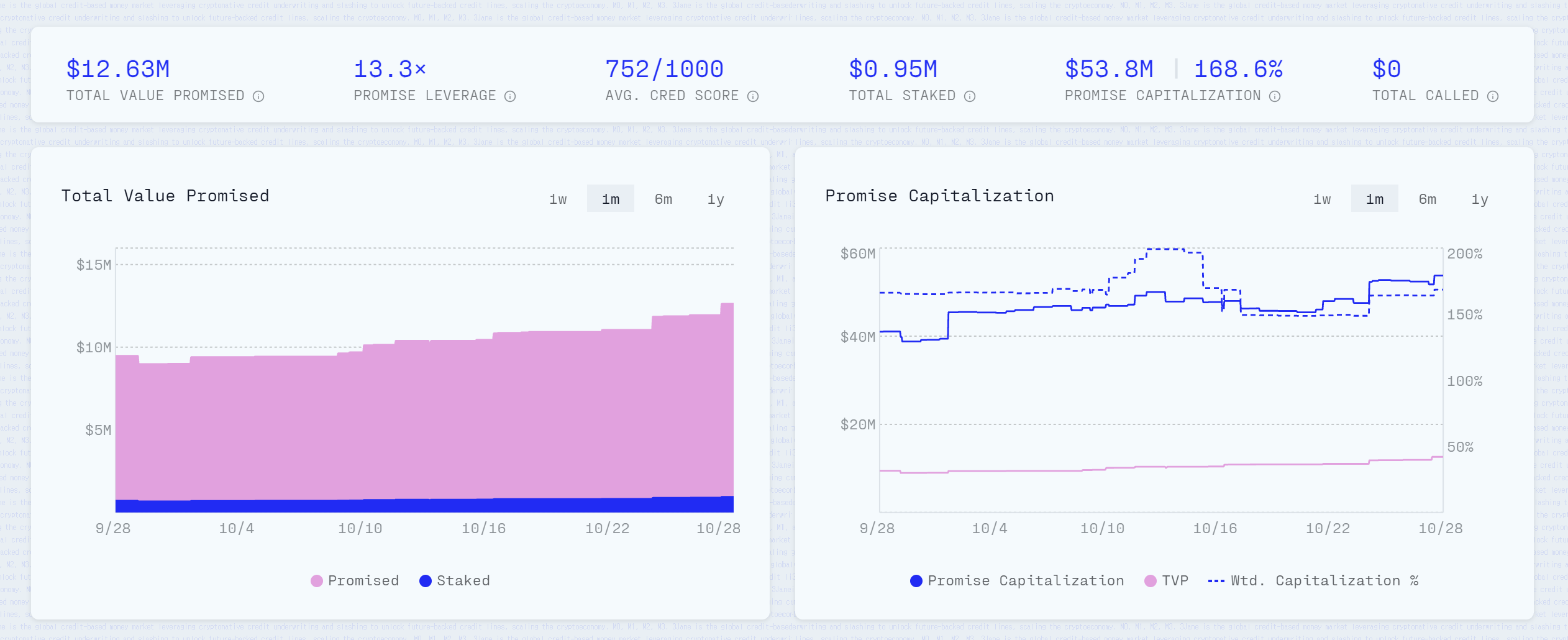
According to the LCC dashboard on 28 October, $12.63 million in funding has been committed, backed by about $0.95 million in margin. Commitments are 13.3 times margin, and over the past month they grew from about $9 million to $12.63 million
Cumulative capital called (Total Called) on the dashboard is still $0, though. Commitments are clearly growing, but how reliably suppliers will honour them when calls actually come has not yet been tested
The most interesting part of LCC is that it puts economic value not only on capital already deposited but on the promise to supply capital in the future.
Where ordinary deposits put the capital already raised to work, LCC tries to put to work the capacity to supply capital that has not been deposited yet
With both in place, 3Jane can raise the capital that current loans need through deposits while using LCC to prepare for loan demand still to come. That makes it possible to run larger facilities without locking up all the capital in advance
Committed money is not the same as cash on hand, of course. Whether suppliers will honour their commitments when markets are unsettled, and whether auctions can find replacement capital when they do not, remains to be proven
Even so, I find it a very interesting structure in that it tries to raise funding efficiency by putting to work not only the capital deposited today but the capital that can be supplied in the future
The bigger credit market FCC and LCC connect
FCC and LCC solve different problems and complement each other. FCC connects credit demand and repayment cash flows from the wider economy through fintechs' customer bases, credit models and receivables; LCC raises the capital that demand needs more efficiently
If both work reliably, 3Jane can grow beyond a DeFi lending protocol into funding infrastructure that fintechs use on an ongoing basis
There is one step further to consider. For now 3Jane is expanding mainly by supplying capital from the crypto ecosystem to credit markets outside it. But once enough lending performance and repayment history builds up, I think it could open the reverse path as well: bringing investment capital from outside crypto on-chain
Traditional asset managers, credit funds and institutional investors already know how to invest in loan receivables. What matters to them is not on-chain technology for its own sake but stable cash flows, clear legal rights, reliable asset reporting and efficient capital management
If 3Jane can meet those conditions while offering the advantages of on-chain finance, it could become a new investment channel even for investors who have stayed out of crypto
LCC could also help with this expansion. Because suppliers do not have to deposit their full commitment up front, they could keep assets invested elsewhere and convert them into USDC when a call comes
That said, bank deposits and traditional financial assets do not currently count directly as eligible LCC margin, and there is little evidence yet of large inflows of capital from outside institutions. Making this work would need further infrastructure for asset verification, settlement, legal rights and liquidity management
What makes the possibility interesting is that the market 3Jane can connect may not be limited to liquidity inside crypto
For now 3Jane supplies crypto capital to credit markets outside crypto, but in the long run it could become financial infrastructure where capital and credit demand from both crypto and traditional finance meet.
Personally, I think this is 3Jane's biggest growth potential
The risks behind the growth story
Turning this potential into real results will take a lot of proving. The risks fall into four groups: credit risk in FCC, funding stability in LCC, the legal structure around off-chain assets, and how value accrues to the JANE token
Credit risk in FCC. More lending does not mean more profit. If the quality of fintech receivables deteriorates, or delinquencies and defaults rise in a downturn, 3Jane's pools can take credit losses. What matters is less how much has been lent than how reliably principal and interest come back
Funding risk in LCC. If committed capital does not arrive when it is actually needed, disbursements to fintechs can be disrupted. There is a mechanism to auction a defaulting supplier's margin to raise replacement capital, but if markets are unsettled and few bidders show up, a liquidity problem can follow. The lack of an actual record of capital calls so far is another reason it needs further testing
Legal and operational risk. Because the business relies on receivables from outside crypto, smart contracts alone cannot control every risk. Much depends on the off-chain financial system: ownership of and security over the receivables, the legal enforceability of contracts, and the management and collection of repayments. In particular, it matters how well investors' rights are protected if a fintech partner runs into trouble
Value accrual to JANE. Finally, it remains to be seen how the protocol's growth translates into the value of the JANE token. Growth in lending, the protocol actually earning a profit, and that profit flowing to token holders are three separate questions. How the fee structure and the token's economic role are designed will be an important variable
In the end, 3Jane's long-term competitiveness depends not on how fast it grows lending and commitments but on whether it can sustain a structure that keeps credit losses in check while reliably supplying and collecting the capital it needs
Credit Beyond Crypto
What first drew me to 3Jane was the idea that DeFi could move beyond collateral-based finance and assess credit and future cash flows. I still see it that way. But looking at how 3Jane has changed recently, I think the opportunity may be far wider than I first imagined
Building a credit market from scratch to rival traditional finance may not be DeFi's only answer. Providing more efficient funding infrastructure to the credit markets that already exist is an important direction too
Fintechs have customers, credit models and loan demand; DeFi has globally accessible liquidity and programmable financial infrastructure. 3Jane is trying to connect the two through FCC and to raise the capital it needs more efficiently through LCC.
It is still early. Neither FCC's long-term lending performance nor LCC's ability to honour real capital calls has been proven yet. I plan to follow the business quarter by quarter and check four indicators
- FCC credit health: delinquency and default rates on receivables, and actual principal collected
- LCC commitment reliability: the share of calls paid in on time, and whether auctions secure capital when suppliers default
- LCC actual use: how much of total commitments turns into capital actually supplied
- JANE value accrual: how the revenue the protocol generates reaches token holders
If this structure holds up at scale, I think 3Jane could grow beyond a DeFi lending protocol into financial infrastructure that connects crypto with credit markets outside it
If the core idea at first was extending credit without collateral, the focus has now widened to where the capital behind that credit comes from and how efficiently it is allocated
From Credit Beyond Collateral to Credit Beyond Crypto.